
The Kodály Concept
The Kodály (click here for the correct pronunciation) concept was inspired by the philosophies of the Hungarian composer and educator, Zoltan Kodály (1882 – 1967). Throughout Kodály’s writings are the notions that a person cannot be complete without music and that music serves to develop a person on all levels – emotionally, spiritually and intellectually.
Kodály believed that every person has musical aptitude and that, ideally, a music education should begin as early as possible in a person’s life – firstly at home and then later within the school curriculum.
Kodály believed that singing should be the foundation of all music education.
“It is a long accepted truth that singing provides the best start to music education; moreover, children should learn to read music before they are provided with any instrument…even the most talented artist can never overcome the disadvantages of an education without singing” (Kodaly, 1974).
The use of the voice is one of the most defining features of the Kodály approach. The voice is the most accessible of all instruments and this makes it most suitable for musical instruction and can lead to a highly developed musical ear. By focusing on learning through engaging with music, singing, playing, moving and enjoying, music becomes part of the natural learning process.
Developmental, Sequential, Cumulative and Continuous Music Education
Kodály believed that musical instruction should reflect the way that children learn naturally. Through singing games, fun and play the child discovers the musical elements as they are presented sequentially and has the opportunity to enter the world of music through the creative development of the ear and the eye.
The Kodály Concept within the Australian Context
Since its introduction into the Australian context the influence of the Kodály concept has been significant in the areas of early childhood, primary and secondary education. Research and training have underpinned endeavours in the ACT, NSW, Queensland, Victoria, South Australia and Western Australia and have encouraged many teachers to strive for a better musical future for their students.
Kodály, Z. (1974). The Selected Writings of Zoltán Kodály. London: Boosey & Hawkes.
The Kodály Concept

Latest News
Cuskelly College of Music 2027 Summer School Music Program
The Cuskelly College of Music has announced details of the Summer School Music Program to be held at St Laurence’s College Brisbane from Monday 4 January to Friday 15 January 2027. The program is extensive and led by national and international experts in their …
Read more
Kodály Australia Conference: Early-bird registration closing soon
A gentle reminder that early bird registration for the Kodály Australia Conference closes this Monday, 31 August 2026, at 11.59 pm ACST. Held only once every two years, this special event is a wonderful opportunity to come together as a Kodály Australia community. If you have …
Read more
Kodály Australia Conference Early Bird Registration Extension
I am pleased to let you know that early bird registration for the Kodály Australia Conference has been extended until 31 August 2026, 11.59 pm ACST. Several people have been in touch asking for a little more time, so I hope that this extension …
Read more
IKS Symposium 2027 Call for Papers
The Call for Papers is now open for the next International Kodály Symposium, to be held in Cork, Ireland, from 4 to 8 August 2027. Submissions are invited for spoken papers, practice-based presentations, workshops, panel discussions, and poster presentations. Full details are …
Read more
Kodály Australia Conference Update
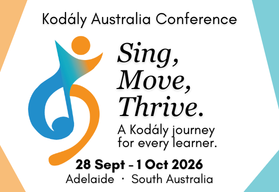
I am delighted to share an update on the Kodály Australia Conference 2026: Sing, Move, Thrive, to be held in Adelaide, South Australia, from 28 September to 1 October 2026. We are excited to welcome an outstanding lineup of national …
Read more
